Cloud-Clone’s antibody guide: match WB, IHC/IF, FCM, ELISA needs with proper Ab traits. 27K+ validated Abs, full tech support.
HUSTON, TX, UNITED STATES, June 2, 2026 /EINPresswire.com/ — Antibody Selection Strategy: Precisely Match Research Needs, Say Goodbye to Selection Difficulties
The most frustrating moment in scientific research is when precious samples obtained through tremendous time and effort yield messy experimental results—multiple non-specific bands, weak signals, or even false positives—simply because the wrong antibody was chosen. Antibody selection may seem like a “small matter,” yet it directly determines the success or failure of experiments and research progress. The key lies in choosing antibodies that match the experimental method and detection targets.
Different experimental scenarios, detection purposes, and sample types demand entirely different antibody characteristics—quantitative assays require sensitivity and specificity, localization assays need resolution and compatibility, and high-throughput detection demands stability and compatibility. Wuhan Cloud-Clone, as an original R&D enterprise deeply rooted in the life sciences field with nearly twenty years of expertise in protein, antibody, and ELISA detection R&D, offers over 18,000 proteins, 27,000+ antibodies, and 8,000+ ELISA kits in stock, building a comprehensive research product matrix covering multiple fields. Today, the antibody experts from Cloud-Clone’s testing department, combining hardcore technology with their comprehensive antibody product system, have systematically compiled an antibody selection guide to help everyone “avoid pitfalls.”
The core of antibody selection is: “Clarify experimental purpose + Match antibody characteristics + Align with detection technology.” The state of antigen epitopes (native conformation vs. linear epitopes), sample processing methods (fixation, permeabilization, denaturation), and detection environments (solid phase, liquid phase, suspension) vary completely across different detection technologies. Cloud-Clone will break down the selection logic one by one:
I. Application Scenario: Protein Identification + Semi-Quantification (e.g., signaling pathway research, protein expression verification)
The core of this type of experiment is to identify the presence of the target protein and compare its relative abundance, commonly using Western Blot (WB) detection technology. The experiment involves protein denaturation, reduction, electrophoresis separation, and membrane transfer. Therefore, antibody selection should focus on the following aspects:
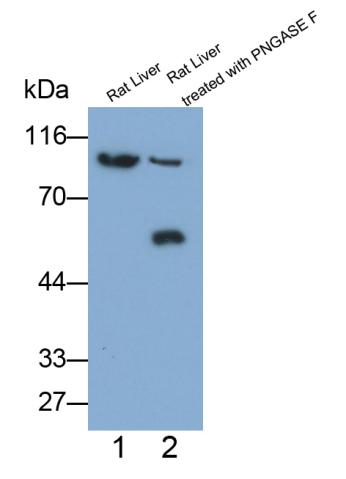
First, choose antibodies labeled “suitable for WB”; second, verify the antibody validation results—for example, the antibody’s official website and datasheet will provide relevant validation result images. Confirm that the detected bands are clear and the molecular weight matches expectations; third, find the immunogen information corresponding to the antibody on the official website, determine the immunogen sequence, and choose antibodies targeting the full-length protein or specific regions. For low-abundance proteins, polyclonal antibodies are often the first choice because they recognize multiple linear epitopes and have a strong signal amplification effect; whereas monoclonal antibodies offer high specificity and clean backgrounds, making them suitable for scenarios requiring precise distinction of splice variants or modification states. The figure below shows a PNGase F deglycosylation validation experiment for CD54 protein in rat liver tissue. The untreated group (Lane 1): the band is located at approximately 95 kDa, significantly higher than the theoretical molecular weight of CD54 (58 kDa). This molecular weight shift is a typical characteristic of extensive N-glycosylation modification. The PNGase F-treated group (Lane 2): after deglycosylation enzyme treatment, the CD54 protein band migrates to 58 kDa, matching the theoretical molecular weight. This result not only confirms the glycosylation modification of native CD54 protein but also fully validates that Cloud-Clone’s CD54 antibody can recognize both glycosylated and deglycosylated forms of the target protein.
Figure 1: PNGase F deglycosylation validation experiment of CD54 protein in rat liver tissue
II. Application Scenario: Protein In Situ Localization + Pathological Correlation Analysis (e.g., tumor marker diagnosis, disease pathology analysis)
This type of experiment requires localizing the target protein within the original morphological structure of tissues or cells, commonly using Immunohistochemistry (IHC) and Immunofluorescence (IF) techniques. The antibody selection for these two techniques has different emphases:
IHC experiments (suitable for clinical diagnosis, pathology research): You need to select antibodies that can withstand antigen retrieval, are compatible with paraffin or frozen sections, and are compatible with enzymatic reactions to ensure clear DAB staining. When selecting antibodies, check the IHC validation result images on the official website or datasheet to verify whether the signal is clear and the background is clean. Cloud-Clone’s IHC antibodies come with IHC validation images accompanied by negative controls, proving their quality with experimental results.
Figure 2: IHC detection results of CK7 marker in human breast cancer tissue
IF experiments (suitable for organelle localization, protein interaction studies): You need to select high-specificity, high-affinity antibodies for precise localization at the sub-organelle level, capable of multiplex staining while avoiding fluorescence interference during co-staining. Also, choose appropriate labeling antibodies to avoid cross-staining. Cloud-Clone provides a comprehensive solution for protein in situ localization, helping to elucidate the correlation between protein function and disease pathological mechanisms. The figure below is a multiple immunofluorescence staining validation experiment in HepG2 cells. The green fluorescence is Alexa Fluor 488-labeled Tubulin Beta 1 antibody, specifically recognizing Tubulin Beta 1; the red fluorescence is TRITC-labeled Phalloidin, specifically labeling F-actin.
Figure 3: HepG2 cell multiple immunofluorescence staining experiment
III. Application Scenario: Single-Cell High-Throughput Analysis + Multi-Parameter Quantification (e.g., clinical disease diagnosis, cell therapy research)
For experiments requiring high-throughput, multi-parameter single-cell analysis, Flow Cytometry (FCM) is commonly used. The key antibody requirements for this type of experiment lie in compatibility with live/fixed cells and the flow cytometry detection system. For live cell detection, choose surface antigens that do not penetrate the cell membrane; after fixation and permeabilization, intracellular/intranuclear antigens can be detected. Antibodies must match the cell species, and directly labeled antibodies (primary antibody directly conjugated with fluorochrome) are preferred for their simplicity and low background; for indirect labeling, choose fluorescent secondary antibodies that match the primary antibody host and have no cross-reactivity. Antibody dosage must be precisely controlled to avoid non-specific binding from excess, and antibodies with fluorescence intensity compatible with the flow cytometer detection channels should be selected. Cloud-Clone’s flow cytometry antibodies are all available with multiple fluorescent labels and can be customized with various flow cytometry channel markers according to customer needs, widely applied in clinical diagnosis, cell therapy research, and other scenarios for efficient single-cell multi-parameter analysis.
Figure 4: Human peripheral blood T lymphocyte subset detection
IV. Application Scenario: Absolute Concentration Quantification of Soluble Proteins (e.g., disease biomarker detection, hormone quantification)
Accurate determination of the absolute concentration of soluble proteins in samples commonly uses Enzyme-Linked Immunosorbent Assay (ELISA). ELISA generally uses antibody pairs (including capture antibody and detection antibody), both of which need to recognize different epitopes of the target protein. The capture antibody should preferentially be a polyclonal antibody with high affinity, and the detection antibody can be a monoclonal antibody with high specificity. The label type must be compatible with the detection method (e.g., HRP). Antibodies must be ELISA-validated to ensure no cross-reactivity and compatibility with sample types (serum, cell supernatant, etc.). Cloud-Clone’s fully self-developed and self-produced system can provide validated antibody pairs, as well as kit products covering 8,000+ indicators, matching user needs in multiple dimensions. Additionally, for cases with large numbers of samples and multiple detection targets, Cloud-Clone recommends using Multiplex Assay kits, compatible with both Luminex and flow cytometry detection methods, capable of detecting dozens of targets in a single run, paired with exclusive antibody combinations to save samples and time.
Figure 5: Multiplex Assay kits standard curve (15-plex)
Cloud-Clone’s 27,000+ antibodies are each validated across multiple dimensions, with fully controlled quality chains ensuring stable performance. Cloud-Clone not only provides high-quality antibodies but also offers technical support with full-process guidance, promoting the standardization of antibody selection and detection technology. With high cost-effectiveness, Cloud-Clone breaks the high-end monopoly, promotes balanced distribution of research resources, serves global research institutions, and drives breakthroughs in life and health fields.
Precise detection is the cornerstone of research; the right antibody is the key to experiments. Cloud-Clone will continue to deepen technology R&D and antibody innovation, providing more precise and efficient products and services, helping researchers overcome difficulties, and safeguarding life and health exploration!
About Cloud-Clone Corp.
Cloud-Clone Corp. is dedicated to the development and production of high-quality immunoassay reagents and detection solutions. With a focus on antibody engineering, multiplex assay development, and cross-platform compatibility, the company provides research tools designed to support precision medicine and advanced biomedical investigation globally. Our core products and services include the research and development of proteins, antibodies, ELISA kits, primary cells, and multiplex cytokine assay kits, as well as professional CRO services to fully meet the diverse needs of biomedical research and related fields.
For more information about Cloud-Clone Corp, visit www.cloud-clone.com.
CLOUD-CLONE CORP.(CCC)
Tel: 001-832-538-0970, 0086-27-8425-9552
Email: mail@cloud-clone.com, sales@cloud-clone.us
Visit us on social media:
LinkedIn: https://www.linkedin.com/company/cloud-clone-corp/
Instagram: https://www.instagram.com/cloudclonecorp2023/
TickTok: https://www.tiktok.com/@cloudclonecorp
SuKi Duan
Cloud-Clone Corp
+86 185 0273 5134
email us here
Visit us on social media:
LinkedIn
Instagram
TikTok
X
Legal Disclaimer:
EIN Presswire provides this news content “as is” without warranty of any kind. We do not accept any responsibility or liability
for the accuracy, content, images, videos, licenses, completeness, legality, or reliability of the information contained in this
article. If you have any complaints or copyright issues related to this article, kindly contact the author above.

Media gallery